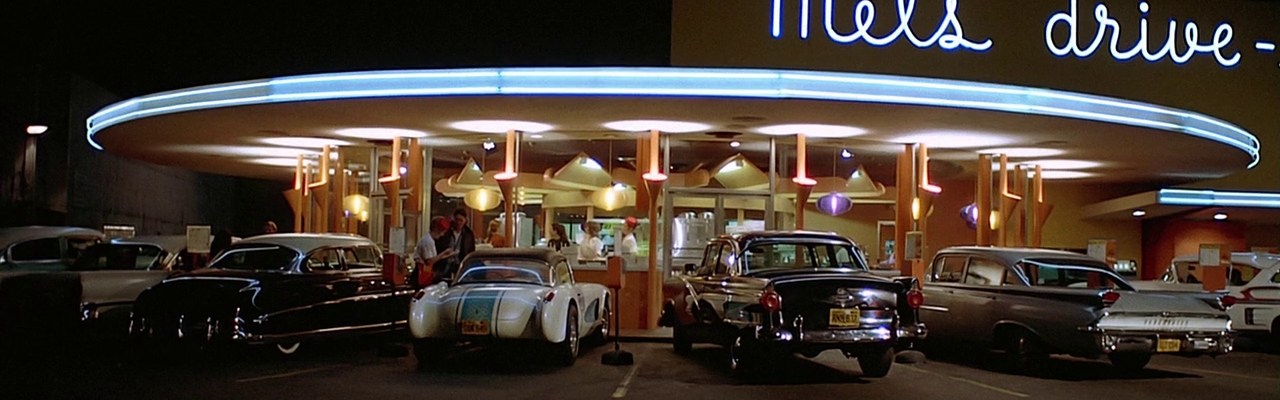
Since abusing Georgia Lucas has become a habit of mine almost as common as abusing George R.R. Martin (what is it with Georges?), occasionally I take the time to look at his non-Star Wars filmography. This is easy, as there are only two other films he’s directed, both before Star Wars froze his auteur vision like a beetle trapped in amber: THX-1138, and his debut, American Graffiti.
For reasons known only to God, I payed good money in the early days of iTunes’ movie service to “purchase” THX-1138. I’ve watched it, twice maybe? I’m not sure I get it. There’s a long stretch in the middle that drags and confused me. It has an interesting vibe. I’ll probably rewatch it at some point.
American Graffiti, on the other hand, is on Netflix, and last night I watched it. It didn’t surprise me, particularly, and it also meandered a bit (was The Phantom Menace an attempt to find his voice again, safely?), but I kinda liked it. It’s the least pretentious thing he’s ever done.
The plot is simple: four buddies in the Valley in 1962, cruising in their various hot rods and steel whales, living it up on the last night before two of them head off to college. Ron Howard is trying to square things with his girlfriend, who’s still got a year of high school. Richard Dreyfuss isn’t sure he wants to go anymore. Sex and gas and Rock n’ Roll ensues.
It’s just that: a slice of life, each boy trying to figure out his own goals, rolling through the night grasping at an unnamed thing. The climax of the movie builds slowly, is almost incidental, but feels earned for all that. Harrison Ford is the heavy, the closest thing to an antagonist, but not really. The antagonist of this film isn’t named until the last shot.
It’s Time, all-devouring, the fire in which we burn. As Richard Dreyfuss flies off into the clear blue sky, we get a fateful epilogue. The hot-rodder was killed by a drunk driver two years later. The nerd went to Vietnam and didn’t come back. Ron Howard sells insurance. Richard Dreyfuss is a presumed dissident exile, a “writer” in Canada.
It’s brutal, and intentionally so. Many have described American Graffiti as an “elegy” for mid-century Americana, and it obviously is. But the movie does more than mourn the bygone era: it slams the coffin lid shut. That age is gone, the ending says. It’s not coming back.
In that respect, my title is a lie: George Lucas is not offering prophylactic nostalgia, the false retreat into an untroubled innocence viewed with rose-colored glasses. Nor is it today’s commercialized Stuck-Culture nostalgia, which exists because Gen-Xers and Millennials can’t experience art outside of the brands they enjoyed as children. It’s more genuine, a Hail-and-Farewell, and the message is that you will lose your youth and innocence regardless of what choices you make. Events are out of your hands. The world rolls on as it does.
In short, I recommend it. And if you find yourself wishing that the director had stayed in this wheelhouse, the film tells you that it probably wouldn’t have mattered.
 Content Blues