Apropos of nothing, I had the theme song to Tiny Toons stuck in my head one afternoon this summer. I sang it, my wife sang it, we knew it, we remembered it.
We are old.
Back in the 1980’s one of the three networks had three hours of Looney Tunes Cartoons on every Saturday morning, from around 7 am to 10. Whatever was happening on a Saturday morning, I was getting my three hours of Bugs Bunny. When it went off and whatever followed it came on, that’s when I got dressed and went outside. Not before. The idea that anything else would be on television on a Saturday morning was an Offense Crying Out to Heaven For Vengeance. All you sheep who watched Miss Bliss’ Class, which became Saved By the Bell, I have not forgiven you. Who wants to watch anything having to do with school on a Saturday morning?
At any rate, in the 90’s, Warner Brothers, having realized that they’d successfully programmed another generation to look back with fondness on characters they’d been milking since the 1930’s, decided that the next move would be a reboot. Instead of Bugs Bunny, we’ll have Buster Bunny (and Babs Bunny, because Warner was waaaaay behind Disney in creating characters of both sexes). Instead of Daffy Duck, Plucky Duck. Instead of Porky Pig, Hamilton J. Pig. Instead of Pepe Le Pew, Fifi La Fume. You get the idea.
The old characters appeared occasionally, as professors at “ACME Looniversity” at which the new characters were attending classes in how to be a Toon or some nonsense (how the shadow of Roger Rabbit hung over these proceedings…). So, an intended Passing of the Baton, the Old Characters granting legitimacy to the New Characters. Each episode was a continuous story, like a sitcom.
It lasted three seasons, from 1990 to 1992, and no one really talks about it today.
What came next was Animaniacs, which had nothing whatever to do with any of the old Looney Tunes characters. Instead, we had the Warner Brothers, Yakko and Wakko, and the Warner Sister, Dot. Just for fun they ran around the Warner movie lot. They locked them in the tower, whenever they got caught, but they broke loose and then vamoosed and now you know the plot.
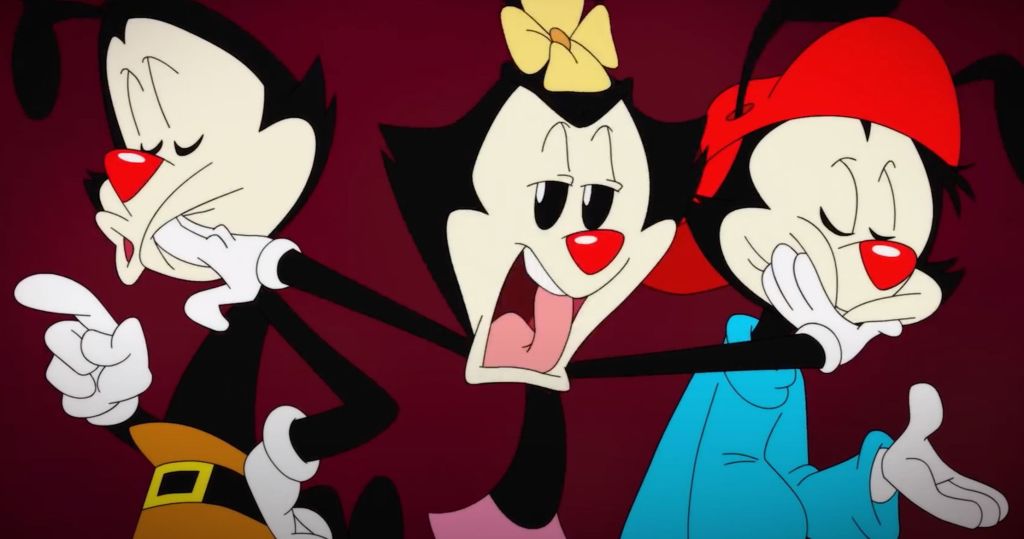
I hope I make my point. Whereas Tiny Toons paid homage to past triumphs, Animaniacs let loose the anarchic spirit that had made the old Looney Tunes cartoons great. Animaniacs gave us a whole new cast of characters: aside from the Warner Brothers (and the Warner Sister), we had grumpy old Slappy Squirrel, Buttons and Mindy (say it with me “okayladyIloveyoububye!”), Freakazoid, and of course, Pinky and The Brain.
No, these never get old.
Animaniacs also returned to the old format: short segments with minimal plot (“the same thing we do every night, Pinky: try to take over the world), maximum silliness, zero continuity, and an explosion of meta. In short, they forgot about Bugs Bunny and returned to his winking contempt for the bindings of reality.
This provides an ample demonstration of what the studios are currently doing, versus what they ought to be doing. The public doesn’t want endless Tiny Toons (how many %&$#@-ing Alien movies will they excrete before the bottom drops out?), and will drop them like hot potatoes when the minimal novelty wears off. The public wants new things, and if you put them under their nose, run the risk like the gamblers you’re supposed to be instead of the accountants you are, you will reap rewards. And decades later, happily entertained dorks will write paeans to your wisdom and foresight.
 Content Blues