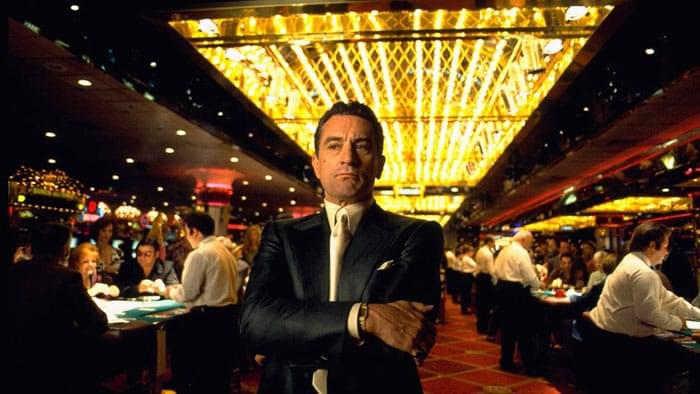
At various times, and especially in my younger days, I would Get Into a movie, watching them over and over, on a nightly or weekly basis, because something in it is speaking to me. I don’t think I am unique in this, but it is a phenomenon I’ve observed in myself. I recently mentioned that I might experience this with The French Dispatch. That didn’t quite happen, but I do still enjoy that film. Examples include:
- The Big Chill
- Reservoir Dogs
- Trainspotting
- Nixon
- And Casino
I had a VHS copy of Casino, back when a movie this long meant two tapes, and I used to watch the hell out of it. I lost that copy some time ago, but last night, it popped onto Hulu, and I watched it for the firs time in years. It lost none of its luster.
There’s no reason to like Casino more than Goodfellas, which it so consciously apes. Push comes to shove, I recognize that Goodfellas is the superior film. But Casino has a bizarre tragic vibe that I keep coming back to, a grandeur, a history, an education. There’s something beautiful and strange and indulgent to it, like Las Vegas itself.
Critics could say that DeNiro and Pacino simply reprise their roles from Goodfellas: DeNiro as the in-control crime-technician, Pacino as the cowboy with the Napoleon Complex. The roles are similar but distinct. Unlike Jimmy Conway, Ace Rothstein doesn’t see himself as a hustler, but as a professional gambler. He only deals with Organized Crime because they control the world he makes his living in. He would prefer things be clean and orderly, and regards Vegas as the Legitimation of his work. He’s not a gangster, he’s a businessman who gets rough when needed.
And unlike Tommy DeVito, Nicki Santoro isn’t a hungry youngster with a big ego and no self-control. He’s a cappo with a big ego, a taste for violence, and some self-control. The difference plays out in the way both characters narrate the story, each from their own perspective. Each feels fully justified in their actions, as necessary to the project of running a mob-controlled Vegas casino in the 70’s. They’re doing everything right, and they can see what the other guy is doing wrong, and even tell him. But neither will listen.
The tragedy of this film is thus twofold: one, Nicki is a Tamburlaine-type, unable to believe that there’s any problem he cannot surmount, any enemy he cannot cow. Even in his long retreat from his position of power, he believes he is winning. He cannot see reality. His narration is cut off mid-sentence.
Ace has a different problem: an inability to believe that the woman he loves does not love him in return. He loves a hooker, the schmuck, and she loves her former pimp, and he refuses to accept this. Why? He falls in love with her when she sticks it to a whale and throws his checks in the air for the mob. A demonstration of strength, of contempt for the masses scraggling for coins, a contempt he quietly shares. She’s bigger than money, she’s bigger than him, and he wants her. Because he wants something, one thing, that isn’t calculated, isn’t oddsed-out to the last digit of probability. He wants something that given to him, not won.
“No one’s ever been so nice to me,” Ginger (played by Sharon Stone, in what I’m convinced his her best role, bar none) says, and anyone with eyes should know that’s the verdict. She can’t respect or be good to someone who’s nice to her. She doesn’t value him for what he is. She wants to, even tries to, but it doesn’t work that way. She feels something different.
That’s one side of Ace’s fall. The other is an inability to tolerate those who lack his devotion, the intolerance of the hyper-competent for the incompetent. There is a moment in the film when everything is still salvageable for him, when all he has to do is hire a connected cowboy mook that he previously let go. He cannot bring himself to do it, and this begins the fall from grace. At the moment of greatest decision, he loses control, by allowing his hyper-fixation on Running the Casino Right to override his instinct to be politic. The political establishment humiliates him like swatting a fly.
One of the things about this movie is how long it is. It has enough energy that you don’t mind the length, but you do feel how long it is. Because, like Goodfellas, the tragedy must play out, bit by bit, slip by slip, until the end feels inevitable and you find yourself wondering how they avoided it this long. It earns its run-time.
One thing I did notice in my viewing last night, something that, having watched the movie only on VHS before, I never caught: at the beginning of the film, when the car bomb goes off, the second before the explosion you can clearly see that Robert DeNiro has been replaced with a dummy. You only notice it for an eyeblink, but I never caught it before. High-resolution can be a curse as much as a blessing.
I hadn’t watched it in a while, and don’t know how soon I’ll watch it again, but I probably will. All of its tragic charms were there, all of its Scorcese energy. It’s not his masterpiece, but say more about Las Vegas, as a city, as a function of America, then just about any other work ever did.

