Certain pieces of music apply to certain times of year. I don’t listen to Joy Division in the summer, that’s January Rock, cold slaps of spare drum beats echoing the frozen ground. And I wouldn’t listen to say, On the Corner in the winter, it’s too wrigglingly alive a piece of music, hot and florid and teeming with sweat. And there are a slew of albums I reserve for this time of year, for that sugar rush of Spring. One of them is Mission Control by the Whigs.
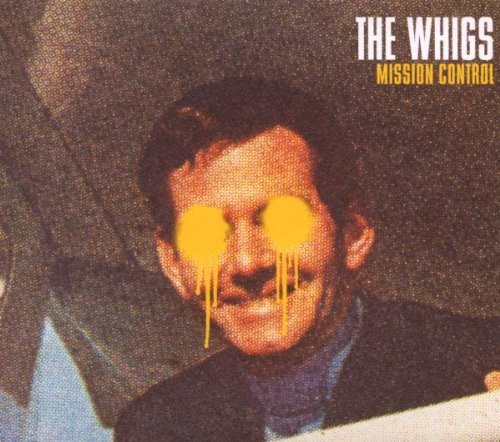
I bought this CD in the summer it came out, 2008, at a Best Buy, for no better reason than I liked the packaging. By this I mean the complete branding excercise: band name, album name, cover art, and a nice blurb on the cardboard endcap promising “sharp, tuneful rock n’ roll”.
It is indeed that. When it came out, Pitchfork was unable to denigrate it, despite admitting in every paragraph that this was all stuff you’d heard a million times before.
Originality is overrated. Indeed, there’s something pleasantly, comfortably, even lovingly familiar about just about every last element of Mission Control, the second album by Athens, Georgia’s the Whigs. A riff there, a crash here, a little bit of purloined melody there, a little bit of swagger here. Taken as a whole, however, the disc adds up to… OK, so it basically adds up to latter day Local H, redux. But it’s hard to fault the Whigs for trying, since they try so damn hard. The secret to the (conditional) success of Mission Control is that the band tackles every last rock’n’roll beat (both literal and figurative) with maximum energy and enthusiasm, mashing rock’s rich history, both mainstream and underground, all together into a sharp power-pop collage.
-Joshua Klein, “The Whigs: Mission Control Album Review” Pitchfork.com
There’s that word “sharp” again. I’d complain but it fits. Every song on this album feels like it was fileted with a razor, leaving nothing unnecessary, yet somehow every song feels full and completely fleshed out. The producer, Rob Schnapf, has a long history of oddball work, starting with co-producing Beck’s Mellow Gold, the first two albums by The Vines, the last two by X, and a host of others I’m not cool enough to know.
We’re getting into the problem with Rock in the 21st Century, which is that nowhere near enough of it sounded this good. Nowhere near enough of it took the effort to mash rock’s mainstream and underground traditions together, to sweat for songs that any bozo could have written. And whenever someone did, whenever someone showed the world what could be done, the industry and the press ignored it, the critics sniffed and said “oh, yes, well-made rock n’ roll, how quaint“. See also, The Hives’ Black and White Album, which came out the year before Mission Control and likewise should have been Album of the Year but lingered in the lower half of the Top 100 before vanishing into the void.
There’s a lot of reasons for all of this, but large among them is the splintering of rock fandom into tiny tribes that wanted nothing to do with one another. MOR bands like Nickelback or Daughtry were lowest-common-denominator enough to sell records, but fans of The Hives or the Whigs or even The White Stripes would have cut their devil-horn fingers off before condescending to listen to a Nickelback song, let alone liking it. We were the Good Rock Fans, and they were lower than the Untouchables of Calcutta.
It doesn’t matter if, on points, The Whigs made a more enjoyable noise than Nickelback did. What matters is that in a time of stiff competition from other genres, rock fans made their most successful acts pariahs. The entire Hipster aesthetic made being a Rock fan niche and snobby, which is something no community can afford if it wants mass appeal.
If I’ve left the station a little here, it’s because I’m trying to justify my interest in this album that everyone’s forgotten about, that deserved better. It’s shouldn’t have been a guilty pleasure, but a recognized step in the development of the music, a reworking of various forms into a sound that people could love. But then we’re several decades past the Beatles turning Rock into parlor music, so maybe it was doomed no matter what happened.
But if there’s life in the old girl yet, if the slow decline of hip-hop and it’s melting into just another form of pop create an opportunity to bring back that Old Time Rock and Roll, when we’ve accepted that we shit on Nickelback (or even Creed) way too hard, then we can talk again about paths not taken, paths that bands like the Whigs showed us, had we been able to see.
 Content Blues